
Quarterly Investment Review
As summer comes to a close, we hope this autumn is off to a wonderful start for you and your loved ones. This quarter, the headlines came from a part of the market that rarely makes the evening news: bonds. Because fixed income is often a cornerstone of a solid long-term strategy, we wanted to give you a clear, simple update on what changed, why it occurred, and how we’re thinking about your portfolio as we head into the final months of the year.
Market Snapshot
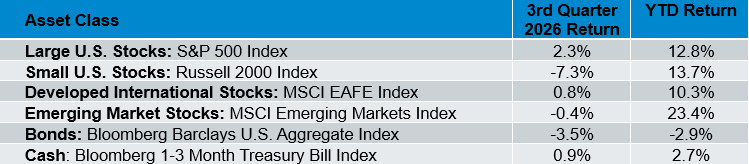
Quarterly Investment Review: Q3 2026
The bond market led much of the conversation this quarter. Long-term interest rates moved sharply higher, with the 10-year U.S. Treasury yield reaching its highest level since 2002 at 5.3%. What made this shift so remarkable was its sheer speed. That yield jumped 0.87% in the third quarter alone, marking the sharpest single-quarter increase since 1994 (U.S. Treasury).
To make sense of this, it helps to understand what drives these rates. While you’ve likely heard about the Federal Reserve raising short-term interest rates during the quarter, the Fed only directly controls the overnight rate for cash (the Federal Funds rate). Longer-term borrowing rates, on the other hand, are set by investors in the open market. Those long-term rates had already been drifting higher all year, but as September arrived, market forces pushed them up at a much faster pace.
Why Rates Are Climbing
A few factors are at work. One that doesn’t get much attention is the global bond market. Much like the price of oil is influenced by global forces, so are interest rates. For example, U.S. investors can buy Japanese bonds, and Japanese investors can buy U.S. bonds. Yields have been rising across much of the world, with countries including Japan and France facing higher financing costs. Inflation is a global concern as well, and investors expect a higher yield to make up for it.
Here at home, large federal deficits mean the Treasury has to issue a great deal of new debt. When supply grows faster than demand, yields generally need to rise to attract buyers. And because interest has become one of the government’s larger expenses, higher rates add to the strain, since the government owes more on the debt it already has. Put simply, investors want to be paid more to lend money for longer stretches of time.
While rising rates can be uncomfortable in the short run, they also tend to improve the forward-looking return potential of bonds. Existing bonds decline in value as newly issued bonds become available at higher yields, and higher starting yields can improve the long-term return of fixed income investments. Historically, starting yield has been an excellent predictor of longer-term bond returns. According to PIMCO, about 90% of a traditional bond investor’s return over five years can be explained by the starting yield (PIMCO).
Today, investors can once again earn attractive yields in relatively conservative fixed income investments. For investors with a long time horizon, we believe this is more of an opportunity than a reason for concern. Bonds follow the math, and the math looks encouraging from here.
Artificial Intelligence Continues to Lead
On the stock side, Artificial Intelligence (AI) remained the driving force. Companies tied to AI led the market for much of the quarter as investors favored businesses connected to semiconductors, data centers, power generation, networking, and the massive infrastructure needed to support AI. Importantly, much of this strength is backed by strong earnings. Corporate America, and the largest companies in the S&P 500 in particular, continues to generate remarkable profits. This isn’t a market built on speculation alone, and the portfolios we manage have benefited from owning many of these successful companies.
Still, strong earnings today don’t tell us what markets will do tomorrow, which is why we’re careful about relying only on the large, familiar technology names.
Market leadership narrowed again during the third quarter. The technology-heavy NASDAQ led the way, while smaller and more value-oriented companies struggled, reversing some of what we saw earlier in the year. During September in particular, the major indexes remained relatively resilient even as a majority of individual stocks declined. Increasingly, a smaller group of AI-related companies has been responsible for keeping the broader indexes near their highs.
Staying Balanced
In AI, enormous capital is being spent today based on the expectation of enormous economic benefits tomorrow. Who ultimately captures those benefits? Will it be the companies building the infrastructure, those developing the models, or businesses using AI to lower costs and improve productivity? Or, as has happened during previous technological revolutions, will some of the greatest benefits ultimately accrue to customers rather than the companies making the largest investments?
We do not pretend to know the answer, and that is precisely the point of diversification.
We want to continue participating in the strong earnings and innovation coming from many of today’s market leaders. But we also recognize that today’s winners will not necessarily be tomorrow’s winners. We do not view being cautious and disciplined as being bearish.
As always, our focus is on keeping your portfolio balanced, with exposure to the opportunities AI is creating alongside value stocks, international equities, fixed income, and alternative investments. We believe diversification, patience, and a long view remain the foundation of successful investing, and we’re committed to that approach on your behalf.
If any of this raises questions, or if you’d simply like to talk through your portfolio, please reach out. We’re always glad to hear from you.
